
Share This Article
Renting does not mean living in a space that feels like nobody lives there. But it does mean navigating the gap between what you want to do and what your agreement allows.
This guide covers exactly where that line is — what you can change freely, what needs your landlord’s permission, and the best renter-friendly design approaches for Indian bedrooms.
Table of Contents
- Know Your Agreement First
- What You Can Do Without Permission
- What Needs Landlord Permission
- What You Cannot Do at All
- Renter-Friendly Design Approach by Element
- When You Move Out — Reversibility
Know Your Agreement First {#know-agreement}
Before any design decision, read your rental agreement for clauses about modifications to the property. Most agreements contain language like “no structural alterations without landlord’s written consent” — but what counts as structural varies.
Standard clause interpretation: painting is usually considered a modification. Drilling for wall anchors may or may not be. Hanging shelves that require screws into the wall is typically covered. Adding furniture, rugs, curtains, and removable fixtures generally is not.
If you are unsure whether a specific change requires permission — ask your landlord in writing. A WhatsApp message asking “Can I hang some shelves in the bedroom?” with a yes response is sufficient documentation.
What You Can Do Without Permission {#without-permission}
[IMAGE BLOCK 2 — Mid-article]
These changes do not alter the property and can be undone completely on move-out:
All soft furnishings — bedsheets, pillowcases, duvet covers, throws, cushion covers. These define the bedroom’s look more than anything else and require zero landlord involvement.
Rugs — a good rug transforms the feel of a room, adds warmth, and reduces noise. No fixing required.
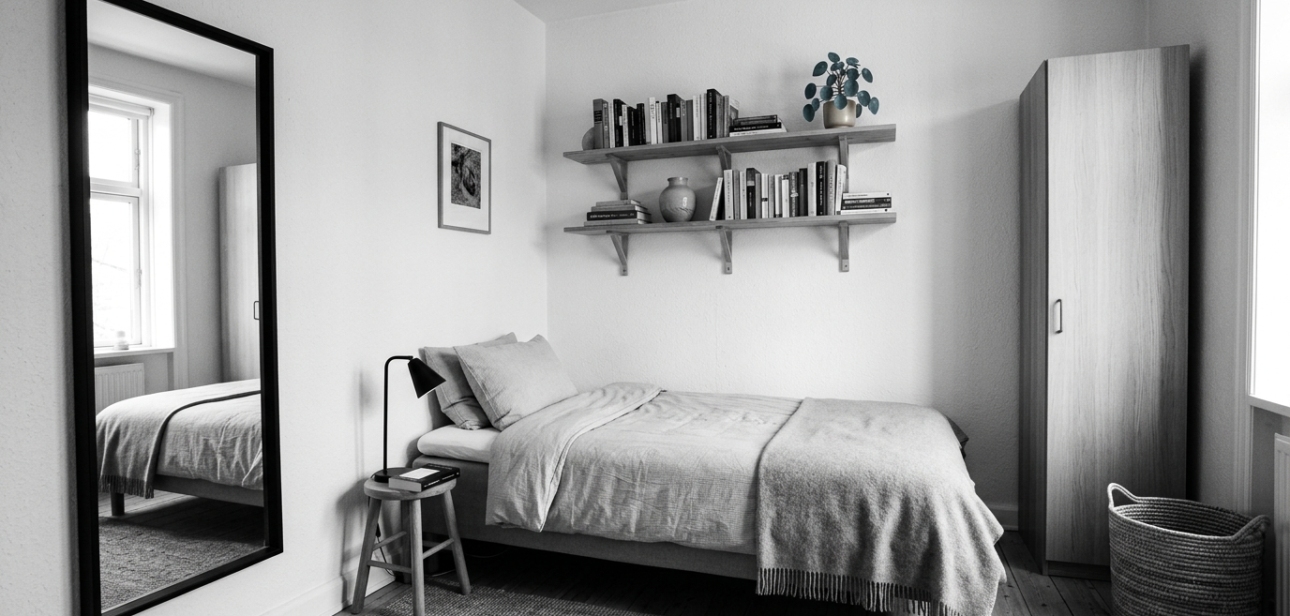
Free-standing furniture — lamps, plants, mirrors on stands, open shelves on legs, storage ottomans, bedside tables, desks. If it stands on the floor and does not touch the wall with fasteners, it requires no permission.
Curtains and rods — tension rod curtain systems require no drilling. These are widely available and hold lighter curtains well. For heavier curtains, the existing curtain fixtures in the flat can often be used with different curtain panels.
Plug-in lighting — floor lamps, bedside lamps, LED strips, fairy lights. All plug-in. No electrician. No permission.
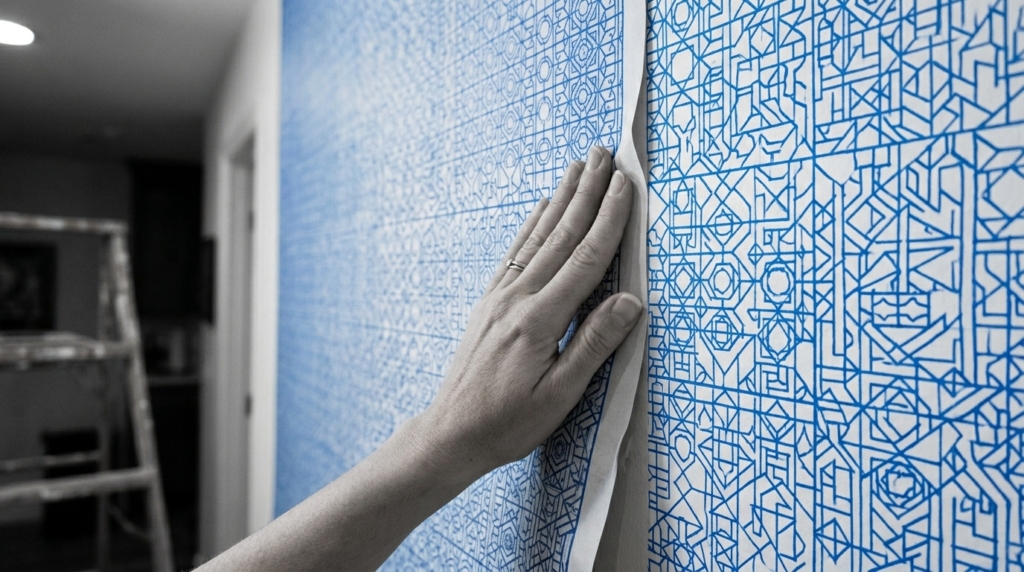
Removable wall decor — peel-and-stick wallpaper, removable decals, and washi tape are designed to come off without damaging the wall. Quality brands marketed for renters (like 3M Command strips for hooks, or renter-grade peel-and-stick wallpaper) leave no residue on standard painted walls when applied and removed correctly.
What Needs Landlord Permission {#with-permission}
Painting — almost universally requires permission. Some landlords permit it with the condition that you repaint in the original colour before leaving. Get this agreement in writing.
Wall drilling for shelves or brackets — requires permission. Reasonable landlords often say yes, particularly if the holes will be filled on move-out. Get it in writing.
Replacing or adding door hardware — hinges, handles, locks — requires permission and usually requires the original hardware to be restored at move-out.
Installing any fixture that involves the electrical system — ceiling fans, additional light points, anything hardwired.
Any modification to the built-in wardrobe or fitted furniture — painting, adding shelving inside, changing hardware.
What You Cannot Do at All {#cannot-do}
Structural changes — removing walls, changing room configuration, alterations to plumbing or electrical systems. These are prohibited in virtually every rental agreement.
Painting walls without permission — even if you intend to repaint, doing it without asking first is a violation. A landlord can deduct for repainting to original colour if you paint without permission.
Installing a ceiling fan where there was none — involves electrical work and is a structural modification.
Replacing flooring — unless explicitly permitted.
Renter-Friendly Design Approach by Element {#by-element}
Walls: The most impactful change. Without painting, use peel-and-stick wallpaper on one wall as a feature. Use Command strips for framed prints arranged in a gallery. Use a large piece of fabric or a tapestry hung from a tension rod near the ceiling for a soft wall covering.
Lighting: Replace the bulb in the existing overhead fitting with a warm white LED bulb — this alone dramatically changes the ambience. Add a bedside lamp and a floor lamp for layered lighting.
Bed and linens: The bed is the room’s focal point. A good mattress topper, quality sheets (400 thread count or above cotton or bamboo), and a well-chosen duvet cover define the room more than any other single element.
Storage: Use a freestanding clothing rack, a bedside caddy, under-bed storage boxes, and over-door organisers to maximise storage without touching the walls.
Plants: Impossible to overstate how much life a few well-placed plants add to a rental bedroom. Snake plants, pothos, and peace lilies are all low-maintenance and suited to bedroom conditions.
When You Move Out — Reversibility {#reversibility}
Document every change you make and how it was done. When you move out, reverse every change that was made with permission and confirm those agreed. For Command strips and peel-and-stick products — follow the manufacturer’s removal instructions carefully to avoid paint damage. For drilled holes — fill with matching filler and touch up the paint if you have a small amount of the original colour.
A bedroom that was designed to be reversible can be completely restored on move-out — which protects your deposit and keeps the relationship with your landlord clean.
Related read: Checklist before moving into rental house ?
Final Thought
Your rental bedroom can look and feel like a space you chose — not just a room someone else owns. The design work is in selecting well, removing what does not belong there, and making reversible choices that honour the agreement you signed.
You are renting the walls. The space between them is yours to make.
More on living better in a rental. Browse our full guide library ?