



Share This Article
The balcony is the most underused space in most Indian apartments. It holds the drying stand, the old bicycle, the suitcase that does not fit anywhere else, and the plant that was moved outside when it got too big.
It could be your morning coffee spot. Your evening reading corner. Your garden. Your meditation space. A small balcony in an Indian apartment — even three by six feet — can be the most used room in the flat if designed deliberately.
Table of Contents
1. Start by Clearing It Completely {#clear}
Every balcony transformation begins with a complete clear-out. Remove everything — the drying stand, the stored items, the old furniture, the broken plant pots. What remains is the actual space you have to work with.
Most balconies look larger than expected once cleared. The perception of a very small balcony is often created by the accumulation of stored items, not by the actual dimensions.
2. Define the Balcony’s Purpose {#purpose}
A balcony without a defined purpose becomes a storage area by default. Decide what this space will be before furnishing it:
Sitting area — a chair or small bench for morning coffee or evening reading. Garden — primarily plants, with a small stool for tending them. Yoga or exercise space — kept clear except for a mat. Workspace — a small table and chair for outdoor working when weather permits.
Choose one primary purpose. Design for that. Secondary uses can be accommodated but the primary use should drive every decision.
3. Choose Weather-Resistant Furniture {#furniture}
All balcony furniture in India must withstand heat, monsoon rain, dust, and humidity. Materials that hold up well: teak or treated hardwood, powder-coated metal, all-weather rattan or synthetic wicker, concrete or stone surfaces.
Materials that do not hold up: untreated wood (warps and moulds), fabric cushions without outdoor-grade covers (mildew in monsoon), and most chipboard or MDF (swells and disintegrates).
For very small balconies, a single chair with a small side table — or a built-in bench along one wall — is sufficient seating. A bistro table and two chairs take roughly 60cm x 70cm of floor area and create a functional outdoor dining spot even on a small balcony.
Foldable furniture is worth considering for balconies where the space is used only occasionally — fold and store inside during periods of non-use or heavy rain.
4. Add Plants — The Balcony’s Primary Decor Element {#plants}
Plants on a balcony do what no other decor element does: they create the feeling of being in a garden rather than in an extension of the flat. Even three or four plants in coordinating pots transform a bare balcony.
Good choices for Indian apartment balconies: Pothos and philodendrons — survive most conditions. Money plant — climbs a trellis or hangs from a bracket. Marigolds — seasonal but easy and colourful. Herbs — tulsi, mint, coriander, curry leaves — practical and aromatic. Bougainvillea — thrives in full sun Indian conditions, dramatic colour.
Group plants at different heights using pot stands, wall-mounted planters, and hanging planters. The vertical dimension of the plant display matters as much as the floor-level arrangement.
5. Use Vertical Space on Balcony Walls {#vertical}
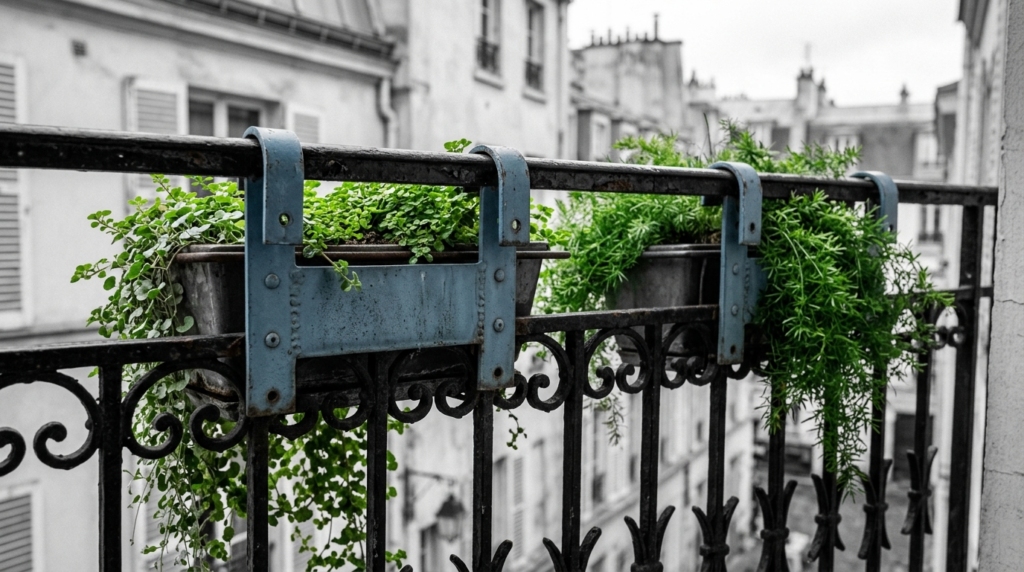
Balcony walls are often completely bare. Wall-mounted planters, a small vertical garden panel, or a mounted shelf for pots takes plants off the floor (freeing space) and creates a green wall effect.
Adhesive-mount or tension-based planters avoid drilling in rental balconies. Over-railing planters hook onto the balcony railing without any fixtures.
6. Add Outdoor Lighting {#lighting}
Evening use of the balcony depends entirely on lighting. Solar-powered fairy lights strung along the railing or across the ceiling of a covered balcony require no wiring and no sockets.
Battery-operated lanterns placed on the floor or on a small table provide warm ambient light. Solar lanterns charge during the day and light automatically at dusk.
Good outdoor lighting transforms the balcony from a daytime-only space to one that is usable and inviting in the evening.
7. Use an Outdoor Rug {#rug}
An outdoor rug on the balcony floor defines the space, adds warmth underfoot, and makes the balcony feel like a room rather than a utility area. Choose a rug specifically designed for outdoor use — these are woven from synthetic fibres that do not mildew or fade in rain and sun.
Available from Amazon, Pepperfry, and local stores from ?800 to ?3,000 depending on size and quality.
8. Create Privacy {#privacy}
Many apartment balconies in India directly face neighbouring balconies or overlook busy areas. Privacy screens — bamboo roll-up screens, outdoor curtains on a tension rod, or a trellis with climbing plants — create a sense of enclosure that makes the balcony feel more comfortable to use.
Bamboo roll-up screens are the most cost-effective option — widely available in India at ?300 to ?800 per meter and easy to fix to railings without permanent installation.
9. Manage the Drying Area {#drying}
In Indian households, the balcony is also the drying area — and there is no point pretending otherwise. The goal is to manage the drying area so it does not define the entire balcony.
Retractable clotheslines that pull out when needed and retract when not used are the most space-efficient solution. Fixed in one corner or along one railing, they leave the rest of the balcony free. Available from Amazon and local hardware stores for ?300 to ?1,000.
10. Monsoon-Proofing {#monsoon}
India’s monsoon season requires specific balcony preparation:
Move or store fabric cushions and upholstered items indoors during heavy rain periods. Ensure plant drainage is adequate — waterlogged pots in monsoon kill plants faster than any other condition. Retract fabric screens and curtains during heavy rain to prevent mildew. Secure lightweight items — small pots, decorative objects — that wind could displace.
A well-designed balcony accounts for monsoon from the beginning — choosing furniture, planters, and decor that are either weatherproof or easily moved indoors.
Final Thought
A small apartment balcony in India is a bonus room that most residents give to storage and drying stands. Cleared, defined, furnished with one or two weather-resistant pieces and several plants — it becomes one of the best spaces in the flat.
The transformation is achievable for under ?5,000 in most cases. The daily benefit is out of proportion to that investment.
More guides for small apartment living in India. Browse our full library ?