



Share This Article
Storage in a small Indian home is never primarily a space problem — it is an organisation problem. Most homes have more storage capacity than they use effectively. The issue is that it is in the wrong places, in the wrong formats, or simply unorganised.
These twelve solutions address the most common storage gaps in small Indian homes — room by room.
Table of Contents
Bedroom Storage {#bedroom}
1. Hydraulic under-bed storage The largest single storage gain available in a small bedroom. A hydraulic bed opens to reveal a full-footprint storage compartment — large enough for seasonal clothing, extra bedding, and suitcases. In a small home where a dedicated storage room does not exist, this is invaluable.
2. Wardrobe internal organisation Most Indian wardrobes are under-used because the interior is not organised. Adding internal organisers — a second hanging rod for shirts, stackable shelf dividers, drawer inserts for small items — can double the effective storage of an existing wardrobe without changing its external size.
3. Over-door hooks and pockets The back of the bedroom door holds bags, belts, scarves, and accessories on over-door hooks (no drilling). A fabric pocket organiser on the back of the door holds small items that would otherwise be on the bedside surface.
Living Room Storage {#living}
4. Floor-to-ceiling floating shelves One wall of floor-to-ceiling shelves in the living room provides more storage than most television units and coffee table combinations combined — while taking zero floor area. Books, decorative items, small storage boxes, and display objects all find a home here.
5. Storage ottoman An ottoman that opens for storage in the living room holds throw blankets, remote controls, charging cables, and other items that would otherwise be scattered across surfaces. It simultaneously serves as a coffee table alternative or additional seating.
6. Console table with drawers or shelves A narrow console table (25 to 30cm deep) behind the sofa or against a wall provides a surface and storage without significant floor area. Choose one with drawers or a lower shelf for maximum utility.
Kitchen Storage {#kitchen}
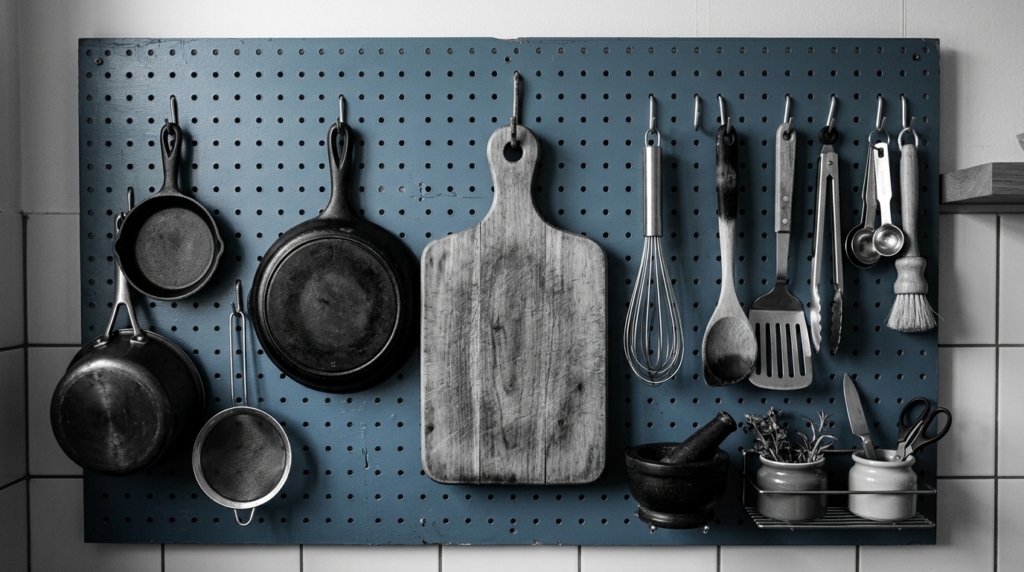
7. Vertical wall organisers A pegboard or grid system on one kitchen wall holds pots, pans, cutting boards, utensils, and small appliances — freeing counter space and cabinet space entirely. Pegboards are available from hardware stores and online for ?500 to ?2,000.
8. Under-sink organisation The cabinet under the kitchen sink is one of the most consistently under-used storage spaces in Indian homes. Adding a pull-out bin, a tension rod for cleaning sprays, and stacking wire baskets can triple its effective storage capacity.
9. Corner shelf unit Kitchen corners — particularly in L-shaped or galley kitchens — are often wasted space. A corner shelf unit or rotating carousel (lazy Susan) in an upper cabinet corner accesses this dead space effectively.
Bathroom Storage {#bathroom}
10. Over-toilet shelf A freestanding shelf unit that sits over the toilet adds three or four shelves of storage without using any floor area. Available from Amazon and local home stores for ?1,500 to ?4,000. Holds toiletries, medicines, towels, and cleaning supplies.
11. Wall-mounted bathroom cabinet If drilling is permitted, a mirrored wall cabinet above the basin replaces the mirror while adding storage. If drilling is not permitted, an adhesive-mount organiser beside the basin mirror provides a small amount of surface storage without wall fixtures.
Entrance and Corridor Storage {#entrance}
12. Entry shoe rack and hook system The entrance of a small Indian home is almost always a bottleneck — shoes on the floor, bags dropped wherever, no fixed place for keys and essentials. A compact vertical shoe rack (rather than a flat floor rack), combined with a row of over-door or adhesive-mount hooks for bags and keys, resolves this immediately.
A narrow bench with storage underneath at the entrance provides seating for shoe-putting-on while adding under-bench storage for additional pairs.
The Universal Principles {#principles}
Three principles that make every storage solution more effective:
Everything needs a fixed home. The reason clutter accumulates is that objects have no designated place. When every object has a specific location, tidying is simply a matter of returning things to their home rather than deciding where they go each time.
Label consistently. In shared homes or for infrequently accessed storage, labels on boxes and containers eliminate the need to open everything to find what you need. Clear containers are even better — visible contents without labels.
Audit regularly. Storage fills up because objects accumulate without corresponding removal. Every three to six months, go through stored items and remove what is no longer needed. This is the maintenance that prevents the storage system from becoming a hiding-away-of-clutter system.
Related read: Checklist before moving into rental house India ?
Final Thought
Storage in a small Indian home is solved not by finding more space but by using existing space more completely and more deliberately. The twelve solutions above address the most common gaps — and most of them cost under ?2,000 to implement.
Start with the bedroom’s under-bed space and the kitchen’s vertical wall. These two changes typically produce the most immediate and visible impact.
More practical guides for small home living in India. Browse our full library ?