



Share This Article
A 1 BHK apartment in a Indian metro city typically ranges from 400 to 650 square feet. It houses one bedroom, a combined living and dining space, a kitchen, and a bathroom. For one or two occupants, it functions adequately. For three or more, it requires deliberate design to avoid feeling perpetually crowded.
This room-by-room guide covers the most effective interior design decisions for each area of a 1 BHK — focused on function first and aesthetics second.
Table of Contents
The Bedroom {#bedroom}
In a 1 BHK, the bedroom typically serves as sleeping space, wardrobe, and often a secondary workspace. The design priorities are storage, light control, and keeping the floor as clear as possible.
Furniture: Hydraulic storage bed, one wardrobe (tall and narrow if space is tight), one bedside surface. Avoid adding a dressing table if the wardrobe mirror suffices. A full-length mirror on the wall or wardrobe door eliminates the need for a separate dressing table entirely.
Lighting: Warm white overhead plus bedside lamp. Blackout curtains for sleep quality — particularly important in metro cities where external light and noise are significant.
Storage: Under-bed, wardrobe interior organisation, over-door hooks. Every storage system in the bedroom should be behind closed doors or out of sightlines.
Related read: Small bedroom design ideas India ?
The Living Room {#living-room}
[IMAGE BLOCK 2 — Mid-article]
The living room in a 1 BHK often combines with the dining area and sometimes doubles as a guest room. The design challenge is making it feel like a dedicated space when it is doing multiple jobs.
Furniture: A compact sofa (two-seater or a corner sofa sized for the room), a low coffee table, one additional seating option (pouf or compact armchair), and a TV unit or wall mount. Avoid oversizing the sofa — a three-seater in a small 1 BHK living room dominates the entire space and leaves no room for anything else.
TV placement: Wall-mounting the TV eliminates the floor area of a TV stand and creates a cleaner visual line. The wall below a mounted TV can be used for floating shelves.
Rugs: A rug defines the living zone and is particularly important in 1 BHK apartments where there is no physical separation between the living and dining areas.
Related read: Small living room ideas India ?
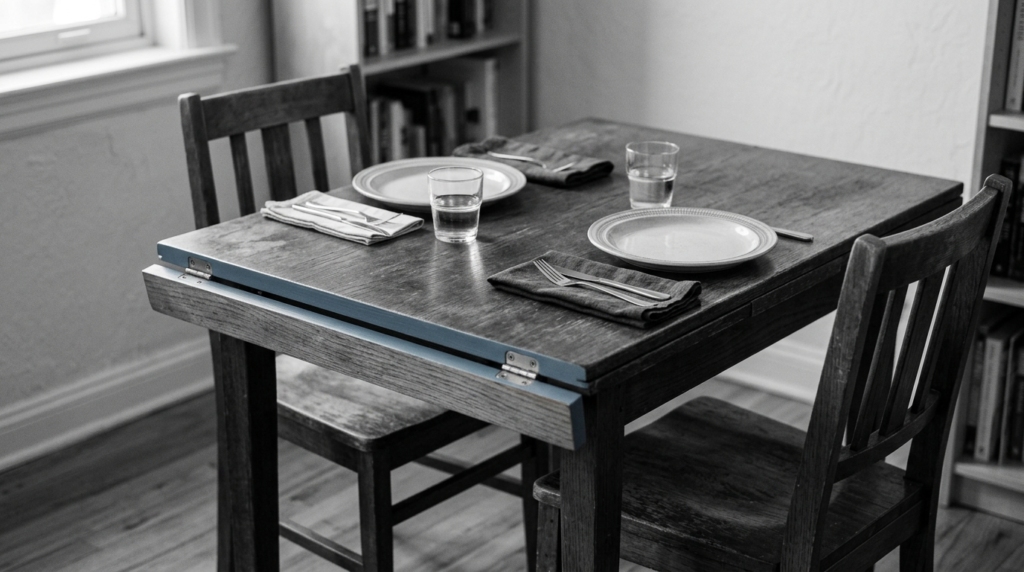
The Dining Area {#dining}
Most 1 BHK dining areas in India are small — sometimes barely enough for a four-person table. Design decisions that help:
Table size: A two-person table that extends to four when needed takes permanently less floor area than a fixed four-person table. In India, these are available from local carpenters and retailers like IKEA and Pepperfry.
Chair choice: Chairs with open frames — metal wire chairs, wooden chairs with slender legs — take less visual space than upholstered chairs with solid bases.
Combining dining and workspace: A dining table that also serves as a workspace during the day eliminates the need for a separate desk in the flat. This requires choosing a table height that works for both eating (74cm standard) and working (same, fortunately).
The Kitchen {#kitchen}
Indian 1 BHK kitchens range from narrow galley kitchens to more open modular layouts depending on the building and developer. The design principles that help in any size:
Counter organisation: Keep the counter clear. Everything that can be stored in a cabinet should be. Knife blocks, spice racks, and appliances that are used less than daily should live inside cabinets, not on the counter.
Vertical storage: Install a pegboard, magnetic knife strip, or hanging rack for frequently used items. Use the space above the upper cabinets for long-term storage.
Under-sink organisation: Use pull-out bins, stacking organisers, and a tension rod for cleaning spray storage to maximise the under-sink cabinet space.
The Bathroom {#bathroom}
Even a small bathroom can be significantly improved through organisation.
Over-toilet storage: A freestanding shelf unit that sits over the toilet adds storage without taking floor area. Available in India for ?1,500 to ?4,000.
Wall hooks: Install hooks on the back of the bathroom door for towels and robes instead of a towel rail that requires drilling. Over-door hooks require no installation.
Mirror cabinet: If the bathroom has a mirror, replacing it with a mirrored medicine cabinet adds hidden storage for medicines and toiletries without adding any visual bulk.
Common Elements Across All Rooms {#common}
Several design principles apply to every room in a 1 BHK:
Consistent flooring or flooring tone — if all rooms have the same floor material, the flat reads as larger. If they have different materials, visual breaks make the space feel more fragmented.
Limited colour palette — using the same two or three colours across the flat creates visual continuity. Each room does not need a different colour scheme.
Light sources in every room — no room should rely on a single overhead light. Lamps, task lights, and natural light supplemented by well-positioned artificial sources make each room functional at different times of day.
Declutter ruthlessly — in a 1 BHK, objects that do not have a fixed home create chaos faster than in a larger flat. Storage systems that provide a designated place for everything are essential.
Final Thought
A 1 BHK in India works well when designed with function as the starting point and aesthetics as the finish. The rooms are small enough that every decision — furniture size, colour, lighting, storage — has an outsized effect on how the flat feels.
Get the function right and the aesthetics follow naturally from it.
Complete design guides for every room in small Indian homes. Browse our library ?