



Share This Article
Most writing about renting in India tells tenants what to do — read the agreement, document the flat, know your rights. Less is written about why these instructions are necessary in the first place.
The reason is structural: the Indian rental market is built around the landlord’s interests. The supply-demand imbalance in metro cities gives landlords significant power. The informal nature of most rental arrangements gives them significant discretion. The slow pace of legal remedies gives them significant protection from consequences.
These are the real problems renters face in India — not edge cases, but everyday experiences.
Table of Contents
1. The Deposit System Is a Financial Trap {#deposit}
In Bengaluru, a ?25,000 monthly rent requires a ?2.5 lakh security deposit at the historical ten-month convention. In Mumbai, six months was standard — ?1.5 lakh on a ?25,000 flat. Before the Model Tenancy Act’s two-month cap began to be enforced, ordinary working people were required to produce the equivalent of their entire annual savings simply to rent a home.
This is not a risk management tool for landlords — it is a financial extraction. Deposits of this size generate meaningful returns when held as fixed deposits. Landlords who collected ten months of rent in deposit were earning passive income on their tenants’ money.
The new two-month cap rules in Karnataka and other states are a genuine improvement. But enforcement is uneven and older practices persist.
Related read: Why security deposit is unfair India ?
2. Discrimination Is Widespread and Largely Unchecked {#discrimination}
“No non-vegetarians.” “Preferred: Brahmin family.” “Not suitable for bachelors.” “No northeast people.” “Only South Indian families.”
These requirements — explicitly illegal, explicitly discriminatory — appear in rental listings across India every day. The Delhi case covered by the Indian Express documented that one in four PCR calls from northeastern residents in Delhi involves landlord harassment. The SPUNER unit exists because discrimination in Delhi’s rental market is sufficiently systematic to require a dedicated police response.
Discrimination based on religion, caste, state of origin, diet, marital status, and family composition is a structural feature of the Indian rental market — not an occasional aberration.
3. Agreements Are Written by Landlords for Landlords {#agreements}
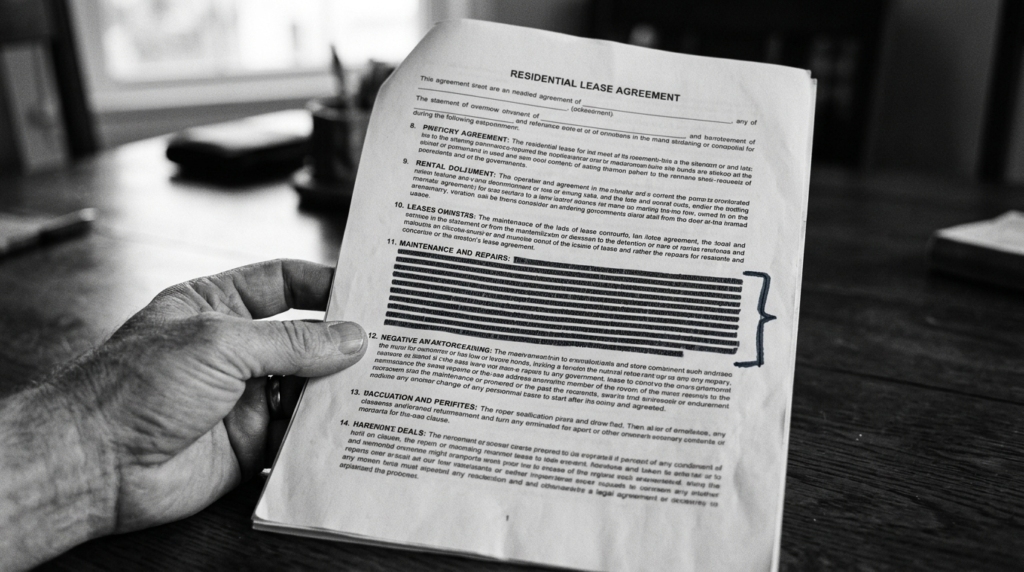
The standard rental agreement in India is not a balanced document. It is typically drafted by the landlord or by a broker working in the landlord’s interest. It specifies tenant obligations in detail and landlord obligations vaguely or not at all.
Most standard Indian rental agreements include: an asymmetric notice period, vague deposit deduction language, no landlord entry restriction, no repair responsibility timeline, and penalty clauses for the tenant but not for the landlord.
Tenants who sign without reading — which is most tenants — are agreeing to terms that are structurally disadvantaged. Tenants who read and question are often met with “this is the standard format” — which is true but irrelevant to whether any specific clause is fair.
4. Privacy Is Routinely Violated {#privacy}
Unannounced landlord visits. Spare keys used while tenants are away. “Just checking” entries that happen whenever the landlord feels like it. Questions about guests, schedules, and lifestyle that are nobody’s business. Pressure to disclose personal details that have no bearing on the tenancy.
The Kerala High Court’s March 2026 ruling — upholding the criminal conviction of a landlord who entered a rented room without permission — addressed one end of this spectrum. The daily reality of unannounced visits and intrusive behaviour occupies the other end, and most of it goes unaddressed because tenants do not know their rights or do not want the conflict.
5. Hidden Charges Are Systematic, Not Accidental {#hidden-charges}
The common electricity charge. The water surcharge. The maintenance fee not disclosed until after signing. The parking charge that was “included” in the verbal discussion but not in the agreement. The move-in fee the society charges that the landlord forgot to mention.
These are not communication failures. They are a business practice. Quoting the rent without the charges attracts more interest. Adding the charges after commitment is easier than disclosing them upfront.
6. Move-Out Is Designed to Extract Money {#move-out}
The viral Bengaluru Reddit post from March 2026 — the birthday buddy who became an ISRO auditor — went viral because it described something millions of tenants had experienced. The inspection team. The detailed assessment. The 10–15 day waiting period. The vague deductions.
Move-out in the Indian rental market is systematically structured to extract money from tenants at the moment when their leverage is lowest — after they have vacated, handed over the keys, and reorganised their lives around the new address.
7. Women Tenants Face Additional Barriers {#women}
Single women, divorced women, and women in non-traditional family arrangements face additional barriers in the Indian rental market — beyond the standard discrimination issues.
Landlords who are comfortable renting to families may refuse single women on vague “safety” grounds that are actually preference grounds. The SPUNER case of the northeastern woman whose landlord used a second phone number to harass her represents an extreme — but the spectrum of intrusive, paternalistic, and discriminatory treatment that single women renters face in India is broad and poorly documented.
8. Families and Children Are Explicitly Excluded {#families}
“No children.” “Families with small children preferred to inquire elsewhere.” These restrictions — often framed as concerns about “noise” or “maintenance” — appear in rental listings across Indian cities. Young families in the rental market navigate a filtering system that excludes them from a significant portion of available properties.
This intersects with the deposit system — families who need larger flats face larger deposits, and the combination of deposit size and discriminatory listing practices creates significant access barriers.
9. The Legal System Is Too Slow to Help Most Tenants {#legal}
A tenant whose deposit has been wrongfully withheld has legal remedies — Rent Authority complaint, consumer court, civil suit. These remedies exist and they work. But they take time. In many cases, months. In civil suits, years.
For a working professional who has moved cities, changed jobs, or simply cannot afford the time and energy of a protracted legal dispute, the practical outcome of a wrongful deposit withholding is often: accept the loss.
Landlords know this. The decision not to return a deposit is, in many cases, a calculation that the tenant will not pursue the matter.
10. The Mental Load of Renting Is Underestimated {#mental-load}
Beyond the specific problems — the discrimination, the hidden charges, the deposit disputes — there is a diffuse mental load that long-term renters in India carry.
The knowledge that the tenancy can end with a notice period. The awareness that the deposit is at risk at move-out. The constant monitoring of the landlord relationship. The need to seek permission for changes that homeowners make without thought. The uncertainty about whether the rent will increase significantly at renewal.
This is not a legal problem or a policy problem — it is a quality of life problem. And it is one that the Indian rental market’s structural imbalances create and sustain.
Final Thought
Naming these problems honestly is not pessimism — it is the first step toward addressing them. The Model Tenancy Act, the Kerala HC ruling, the SPUNER unit, the new deposit cap rules in Karnataka — these are all genuine improvements.
But the gap between what the law provides and what renters actually experience in India remains significant. Closing it requires both better enforcement and more tenants who know their rights well enough to exercise them.
Know your rights. Use them. Browse our full tenant guide library ?