



Share This Article
Paying less rent in India does not require any tricks. It requires knowing your options — before you sign, during the tenancy, and at renewal. Here are six legitimate ways to reduce your rent that work across different situations and markets.
Table of Contents
1. Negotiate Before Signing {#negotiate}
The most consistently effective way to reduce rent is to negotiate before signing. Most landlords in India expect some pushback and have priced a margin into the asking rent. Tenants who do not negotiate pay that margin unnecessarily.
The key is to come to the negotiation with market comparables — similar properties in the same area at lower prices — and a compelling case for reliability. A tenant with stable employment, references, and a willingness to sign a longer-term agreement is worth a rent concession to most landlords.
Start by researching actual transaction prices — not listed prices — in your target area. The gap between asking and closing is your negotiation range.
Related read: How to negotiate rent India ?
2. Use Rent Control Laws Where They Apply {#rent-control}
In states with active Rent Control Acts — Delhi, Maharashtra, Tamil Nadu, West Bengal, Karnataka — there are legal limits on how much rent can be charged for certain categories of property. These limits are typically based on a standard rent calculation tied to the property’s construction cost and area.
For older properties — particularly those constructed before the 1970s or 1980s — standard rent under the applicable Rent Control Act may be significantly below current market rates. Tenants in these properties have a legal right to pay only the standard rent if they can establish it through the Rent Controller.
This route is complex and requires legal advice — but in cities where rent control properties exist (particularly Delhi and Mumbai), it can be a legitimate basis for challenging an excessive rent charge.
3. Challenge an Excessive Deposit Under the New Cap Rules {#deposit-cap}
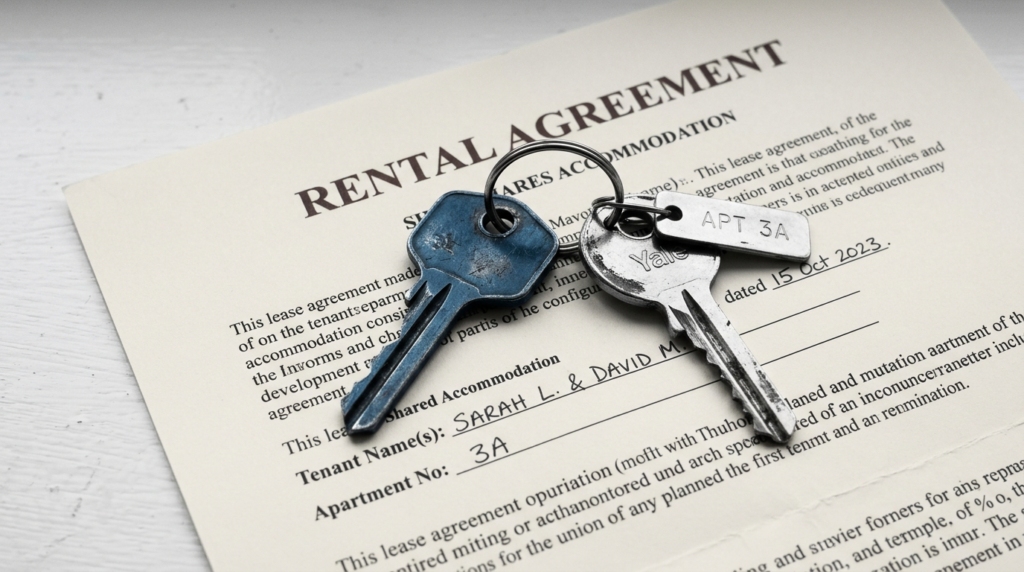
Under the Model Tenancy Act framework and Karnataka’s 2025-26 rental rules, the security deposit for residential properties is capped at two months’ rent. Legally, a landlord cannot demand more.
Challenging a deposit amount above this cap is a legitimate legal action — but it indirectly affects your rent. The cash you get back from a deposit reduction is money you keep rather than giving the landlord the interest benefit on it.
On a ?50,000 per month flat where the landlord demands six months’ deposit (?3,00,000) but the legal cap is two months (?1,00,000), you retain ?2,00,000. At 6.5% annual return, that is ?13,000 per year in your pocket rather than effectively subsidising the landlord.
This is a rent reduction by another name.
Related read: Why security deposit is unfair India ?
4. Get a Roommate {#roommate}
The simplest and most immediate rent reduction: split the cost with one or more roommates. A ?25,000 monthly rent becomes ?12,500 each with one roommate. A ?35,000 two-bedroom becomes ?11,667 each with two roommates.
Before adding a roommate, check two things: whether your rental agreement permits it (most standard agreements include a no-subletting clause — adding a roommate is usually permissible as a co-occupant, but get landlord’s written permission to be safe) and whether the society rules permit additional residents.
5. Trade Services or Commitments for Rent Reduction {#trade}
Some landlords will accept a rent concession in exchange for something that has value to them:
Longer tenancy commitment — a two-year agreement reduces the landlord’s vacancy and re-letting cost. Many landlords will accept a ?1,000 to ?2,000 monthly reduction in exchange for a two-year commitment.
Paying multiple months upfront — some landlords value cash flow certainty. Paying three or six months upfront (if you have the capital and the deposit is secure) may earn a discount.
Reliable payment commitment — explicitly agreeing to pay by standing order on the first of the month, in writing, has value to landlords with bad payment history from previous tenants. This is worth explicitly proposing in exchange for a price concession.
6. Move to a Better-Value Area or Property Type {#move}
The most significant rent reduction available in any Indian metro is a strategic move to a better-value area. The rent premium for proximity to major employment hubs is substantial — and for tenants with flexible commute arrangements, this premium is often not worth paying.
A 2 BHK in Indiranagar, Bengaluru at ?45,000 per month might find a comparable property in HSR Layout at ?35,000. The commute adds thirty minutes — but ?10,000 per month represents ?1,20,000 per year.
Similarly, independent houses in most Indian cities offer more space at lower per-square-foot rent than apartments in gated communities. If the amenities are not a priority, the independent house option often provides a meaningful cost reduction.
Related read: Apartment vs independent house rent India ?
Final Thought
Reducing rent legally in India is not about exploiting loopholes — it is about knowing your options and using them deliberately. Negotiate before signing. Know what the law caps. Understand the value of reliability to a landlord. Consider structural decisions — roommates, area choices — as rent reduction tools.
The tenants who pay the least for good housing are the ones who approach the market with information rather than desperation.
More guides for renting smarter in India. Browse our full library ?