


Share This Article
The conversation started simply enough.
“Jason, I’m done. You owe over ten grand in rent. I can’t keep carrying this.”
What followed was a text exchange between a UK landlord and his tenant that was reshared by property strategist Jake Rooke and viewed by thousands — not because the situation was unusual, but because it was painfully familiar to landlords across the country.
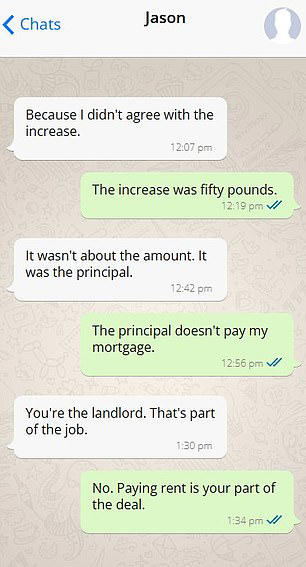
Jason had paid rent for three years. Then, over the next 14 months, he paid nothing. The reason he gave: he disagreed with a £50 rent increase. The principle, he said, was the issue. Not the amount.
“The principal doesn’t pay my mortgage,” the landlord replied.
Table of Contents
The Exchange {#the-exchange}
[CHAT PLACEHOLDER 1 — Landlord opening message]
“Jason, I’m done. You owe over ten grand in rent. I can’t keep carrying this.”
[CHAT PLACEHOLDER 2 — Mid exchange]
Jason explained he was still looking for somewhere to move but the market wasn’t easy. The landlord said he’d been hearing the same excuse for months. Jason said the flat felt like home after five years. The landlord pointed out that three of those five years included rent being paid — the last fourteen months did not.
When Jason explained he had stopped paying because he disagreed with a £50 increase and that it was about “principle,” the landlord replied: “The principal doesn’t pay my mortgage.”
Jason said: “You’re the landlord. That’s part of the job.”
The landlord replied: “No. Paying rent is your part of the deal.”
[CHAT PLACEHOLDER 3 — Final exchange]
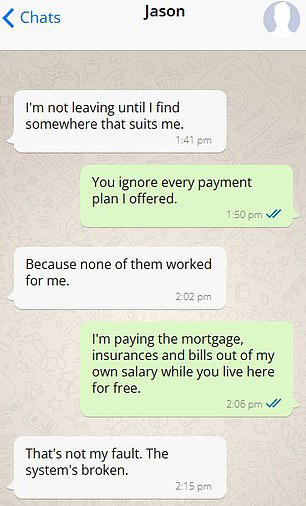
Jason said he was refusing to move until he found somewhere that suited him. The landlord said he had already applied to court for eviction. Jason pointed out that court proceedings would take months.
“So your plan is to stay here rent-free until a judge forces you out?”
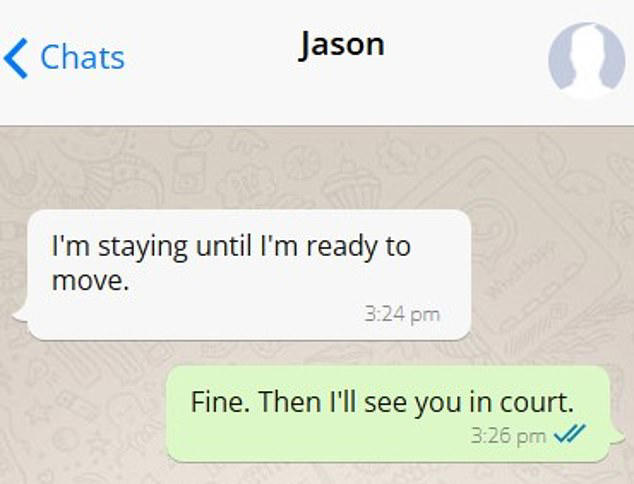
“I’m staying until I’m ready to move.”
The exchange ended: “Fine. Then I’ll see you in court.”
Jason’s Logic {#jasons-logic}
[IMAGE BLOCK 2 — Mid-article]
Jason’s position — that the system is “broken,” that a £50 increase justified 14 months of non-payment, that the landlord’s job includes absorbing the cost of a non-paying tenant — is not a legal argument. It is a moral one.
And while many who read the exchange expressed little sympathy for Jason, his final move — “If you want me out, take it to court” — is legally accurate in the UK. A landlord cannot physically remove a tenant without a court order. The process takes time. And Jason knew it.
The claim that he stopped paying “on principle” over a £50 increase — on a presumably higher monthly rent — is difficult to defend logically. But the UK’s court-heavy eviction process means that knowing how the system works is its own kind of leverage.
What the Landlord Was Dealing With {#landlord-situation}
The landlord had been covering the mortgage, insurance, and all property bills out of his own salary for 14 months while Jason lived rent-free. He had offered payment plans. All were rejected by Jason as not working “for him.”
He had applied to the court. He was now waiting.
The responses from other landlords who shared the post were bleak. One described a tenant who left behind significant damage and filth. Another said the experience had changed their entire retirement plan. Several described the judicial process to remove non-paying tenants as “an absolute joke.”
What UK Law Says About Rent Arrears {#uk-law}
In the UK, a landlord cannot simply change the locks or remove a tenant’s belongings. Even when rent has not been paid for over a year, the process for legal eviction runs through the courts.
To evict for rent arrears, a landlord must serve a Section 8 Notice — currently requiring that at least two months’ rent remains unpaid both when the notice is served and at the time of the court hearing. The notice period is two weeks. Court hearings add further delay, and even after a possession order, bailiff enforcement can add additional months.
According to data cited in UK property coverage, the average time from first missed payment to physical repossession is approximately 27 weeks — and that is in a best-case scenario. Court backlogs, tenant defences, and suspended possession orders can extend this significantly.
The Renters’ Rights Act and What Changes in May 2026 {#renters-rights}
The UK’s Renters’ Rights Act, which comes into force on 1 May 2026, changes the eviction framework in significant ways.
Section 21 “no-fault” evictions — where landlords could remove tenants simply by giving notice, without citing a specific reason — are abolished. From May 2026, landlords must use Section 8 for all evictions, citing specific statutory grounds.
For rent arrears specifically, the threshold under the reformed Ground 8 increases from two months to three months of unpaid rent before mandatory eviction proceedings can begin. The notice period also increases from two weeks to four weeks.
This means that for cases like Jason’s, the timeline for a landlord to initiate mandatory eviction proceedings actually gets longer under the new rules — requiring more arrears before the mandatory ground is triggered.
The Renters’ Rights Act is primarily designed to protect tenants from no-fault evictions and unfair conditions. But its interaction with rent arrears cases creates a longer minimum path to eviction for landlords dealing with non-payment.

The Real Cost of Eviction in the UK {#real-cost}
According to the High Court Enforcement Officers Association, the average rent loss a landlord sustains by the point of eviction is £12,708 nationally — rising to £19,223 in London. That figure reflects the cumulative arrears, court costs, and void period losses that accumulate during the months-long eviction process.
For landlords running buy-to-let properties on mortgages — covering payments out of rental income — a non-paying tenant is not just a cash flow problem. It is a potential mortgage default.
The landlord in this case had been carrying that cost for 14 months before the text exchange was ever sent.
Final Thought
The viral text exchange between this UK landlord and Jason is uncomfortable reading — not because Jason is a villain, but because the system he described is real. The court process is slow. The timeline is long. And knowing that gives certain tenants a kind of leverage that has nothing to do with the law’s intent.
At the same time, 14 months of non-payment on principle over £50 is also real. The landlord’s mortgage didn’t pause. The insurance didn’t pause. The bills didn’t pause.
“Fine. Then I’ll see you in court” is where the conversation ended. For the landlord, that was not the end of the problem. It was just the beginning of the paperwork.
Renting in India and want to know your rights and obligations? Browse our full tenant guide library ?