



Share This Article
Your first rental flat in India is a milestone — first city, first job, first home that is entirely yours. It is also the moment when you are most vulnerable to the mistakes that cost tenants money and stress.
Nobody gives you a manual for renting. Landlords do not explain your rights. Brokers do not explain what they are not telling you. The agreement is placed in front of you and you are expected to sign.
This guide is the manual nobody gave you.
Table of Contents
- Before You Start Searching
- What the Broker Is Not Telling You
- The Viewing — What to Actually Look For
- The Agreement — What First-Timers Miss
- Move-In Day — The One Thing That Protects Everything
- Month-to-Month — The Habits That Protect You
- Move-Out — Where First-Timers Lose Money
- Your Rights — The Short Version
Before You Start Searching {#before-searching}
Before looking at a single flat, know your actual budget. Not just the rent — the total monthly cost. Add maintenance charges (?1,500 to ?5,000 in most gated communities), parking (?500 to ?2,000 if separate), any water surcharge, and the common electricity charge that appears in some buildings.
The flat listed at ?18,000 often has a total cost of ?22,000 once all charges are added. Know this before you fall in love with a listing.
Also calculate what the deposit will cost you. Under Karnataka’s new rules, deposits are capped at two months’ rent. In other states, the convention can still run to six months or more. Know the deposit requirement upfront — it is a large sum that must come from savings before you even move in.
What the Broker Is Not Telling You {#broker-truth}
Your broker is being paid to close a deal. This creates a specific set of things they will not volunteer:
They are often being paid by both you and the landlord — collecting brokerage from both sides without disclosing it to either. The flat has been empty for two months because it has a problem they have not mentioned — water pressure issues, noisy neighbours, or a difficult landlord. The agreement they are facilitating is the landlord’s standard template that has not been reviewed for fairness.
Ask directly: are you collecting brokerage from the landlord as well? Why has this flat been available for this long? Can I make changes to the agreement?
Related read: Broker scams India — how to spot them ?
The Viewing — What to Actually Look For {#viewing}
First-time renters spend the viewing admiring the flat. Experienced tenants spend it testing it.
Test every tap for water pressure. Run the shower for sixty seconds. Flush the toilet. Test the geyser. Open every window and door — does it close properly? Test every electrical switch. Stand in every room and test your mobile signal. Look at the ceiling and walls for water stains.
Also look at the landlord during this process. How do they respond when you test things? Are they comfortable with your inspection or subtly deflecting?
Related read: What to inspect before renting India ?
The Agreement — What First-Timers Miss {#agreement}
The agreement will be presented as “standard.” It is not a fixed document — it is a starting position.
Read it fully before signing. The things first-timers typically miss: an asymmetric notice period (the landlord can ask you to leave faster than you can leave without penalty), vague deposit deduction language that gives the landlord unlimited discretion, no entry restriction clause (the landlord can visit without notice), and no repair responsibility timeline.
All of these are negotiable before signing. None of them are negotiable after.
The most important clauses to negotiate: a symmetric notice period, specific deduction criteria for the deposit, a clear escalation cap, and a 24-hour advance notice requirement for landlord entry.
Related read: 5 essential rent agreement clauses ?
Move-In Day — The One Thing That Protects Everything {#move-in}
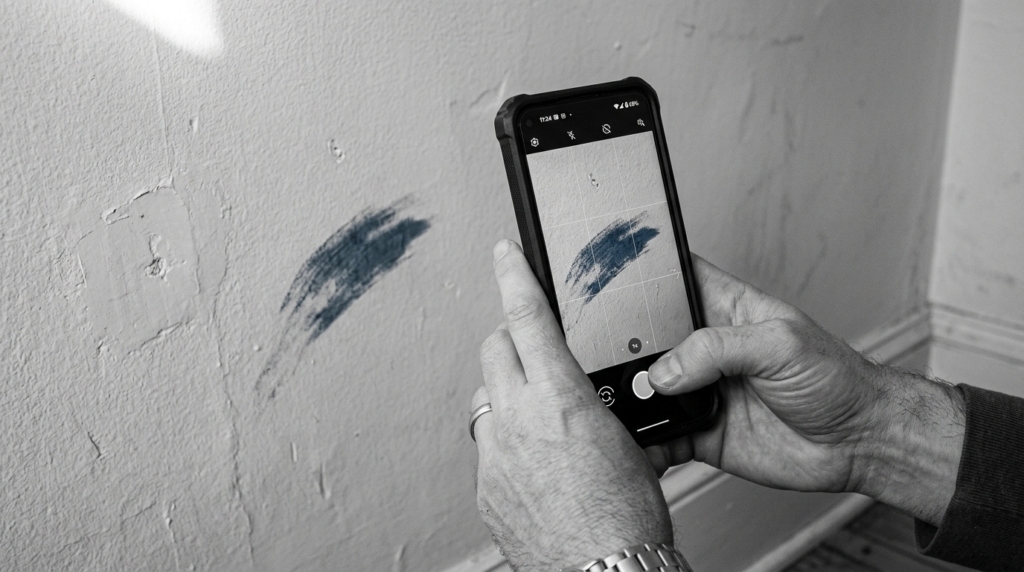
Photograph the entire flat on move-in day. Every wall. Every appliance. Every floor. Every fixture. Every scratch, stain, and mark you can find.
Share the photographs with the landlord immediately via WhatsApp. This creates a timestamped record that both parties have seen and acknowledged.
This single action protects more of your deposit than anything else you will do during the tenancy. The landlord who tries to deduct for a scratch that was there when you arrived cannot do so if you have a photograph dated your move-in day showing it was already there.
Thirty minutes on move-in day. The most valuable thirty minutes of your entire tenancy.
Month-to-Month — The Habits That Protect You {#habits}
Three habits that protect first-time renters throughout the tenancy:
Pay by bank transfer, always. Every transfer is an automatically dated, documented receipt. You never need to chase a paper receipt because the transaction record does all the same work.
Get a rent receipt every month for HRA. If your salary includes HRA — even if your employer does not ask for receipts — collect them monthly. If you ever need to claim the exemption, monthly receipts are required.
Put everything in writing. Every request, every complaint, every conversation with your landlord that has financial or legal implications — follow it up with a WhatsApp message confirming what was discussed. You do not need to be formal. You just need a timestamped record.
Related read: Rent receipt for HRA India ?
Move-Out — Where First-Timers Lose Money {#move-out}
The move-out is where first-time renters most often make expensive mistakes:
Handing over keys before the deposit is settled. Once the keys leave your hand, your leverage is gone. Do not hand over the keys until you have either the deposit back or a written settlement document specifying the exact amount and return date.
Not doing a joint inspection. Request a walk-through with the landlord before vacating. Compare the flat’s current condition to your move-in photographs. Agree on any legitimate deductions in writing. Any deduction added after this point — for something not identified in the joint inspection — has no documented basis.
Accepting verbal assurances about the deposit. “I’ll transfer it by the end of the week” is not a commitment you can enforce. “I will return ?50,000 (minus ?5,000 for professional cleaning) by [specific date]” sent in a WhatsApp message is.
Related read: How to get deposit back fast India ?
Your Rights — The Short Version {#rights}
As a first-time renter in India, you have rights that exist regardless of what your agreement says or what your landlord tells you:
Your landlord cannot enter your flat without 24 to 48 hours advance notice (except emergencies). Your landlord cannot increase your rent mid-tenancy without your written agreement. Your landlord cannot cut off essential services — water, electricity — under any circumstance, even during a dispute. Your landlord cannot evict you without proper written notice and, in most cases, a court order. Your security deposit must be returned within the agreed timeline with documented deductions only.
Knowing these rights before you need them is the difference between a good first rental experience and an expensive one.
Related read: Tenant rights India — 8 protections every renter has ?
Final Thought
Your first rental in India will teach you more about the rental market than any guide can. The goal of this guide is to make sure what you learn costs you as little as possible.
Document everything. Read the agreement. Photograph the flat at move-in. Do not hand over keys without a settled deposit.
These four things, done consistently, make the first rental experience manageable rather than expensive.
Everything you need for every stage of renting in India. Browse our full library ?